

-
負責人王虹穎
-
統編90324753
-
人數11 - 50 人
-
資本額700 萬
-
地址臺北市信義區暫不公開
In 2025, IQronix launched as a specialized deep-tech division, focused on accelerating the productization and scalable deployment of embedded systems—across kernel, firmware, and advanced edge AI—for leading technology companies.
Our foundation is delivery, not just design. We bring essential system stability and scalability to mission-critical platforms.
Code of Honor
· Integrity · Ownership · Deliver Excellence · Accountability · Transparency · Speak-up Culture
Competitive compensation with 13-month salary
Bonuses for major traditional festivals (Chinese New Year, Dragon Boat Festival, Mid-Autumn Festival)
National Labor Insurance and National Health Insurance in accordance
Additional group insurance coverage
Leave policy more favorable than the Labor Standards Act
Flexible working hours
One day of work from home per week
Comfortable and supportive working environment
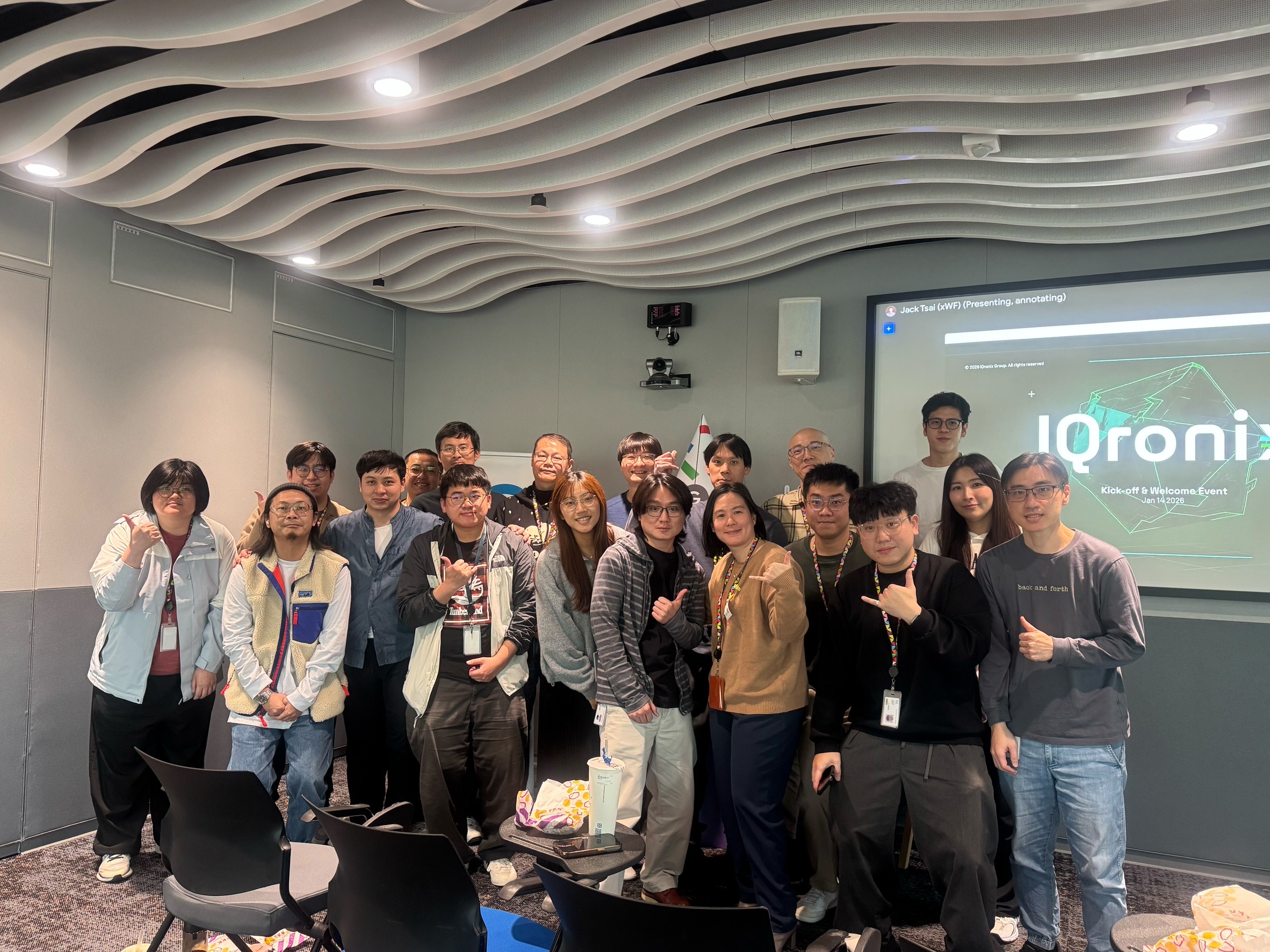
Occasional team gatherings and company events
IQronix is a Managed Services Provider (MSP) delivering high-impact R&D and large-scale deployment solutions for global tech leaders, including FAANG companies. We bridge complex engineering with real-world execution. The Mission We are hiring a Smart & Fast Operator at the intersection of Corporate Marketing and Business Operations. This hybrid role is for a digitally savvy individual who learns fast, anticipates needs, and solves problems before they escalate. You will operate across functions as a Marketing Associate, Executive Assistant, and Operations Coordinator. Key Responsibilities 1. Marketing & Brand -Execute branding for a global, technical audience -Develop content and communications aligned with enterprise clients -Create sales materials to support business growth 2. Operations & Finance - Support alignment across HR, Growth, and Operations - Track budgets and assist with basic financial reporting - Improve internal workflows and communication 3. Project Execution - Manage multiple priorities in a fast-paced environment - Deliver time-sensitive tasks with speed and accuracy - Identify and resolve bottlenecks independently 4. Global Coordination - Work across international teams and stakeholders -Track tasks and timelines across regions and time zones
Job Overview This position is responsible for the quality assurance of Android AI products. The core mission is to drive the evolution of automated testing frameworks through engineering methods. You will directly participate in system architecture migration, solve adaptation challenges across multiple chipset platforms, and maintain the infrastructure that supports large-scale AI testing. Core Responsibilities 1. Test Engineering & Migration Drive Architecture Upgrades: Participate in the technical maintenance and new feature development of the ARTS framework, leading the configuration unification and migration from legacy versions to the new version. Cross-Platform Integration: Perform test integration for various underlying chipset frameworks and solve technical challenges arising from hardware differences. Develop Specialized Test Modes: Implement new features such as Non-LLM execution modes and audio testing capabilities. 2. Devices Lab Management High Availability Management: Operate and maintain the lab automation platform, ensuring the server achieves a 99.9% uptime target. Hardware Resource Optimization: Proactively identify and resolve laboratory hardware bottlenecks and manage the configuration of diverse AI test devices. 3. Model Quality & Visibility Automated Monitoring Development: Build and maintain data visualization dashboards to monitor key KPIs such as scores, model names, and runtimes. Metric Benchmarking: Execute advanced model evaluation metrics and conduct baseline comparison analysis. 4. Non-Functional Validation Hardware Performance Evaluation: Validate on-device resource utilization (Memory, CPU, and Thermal) during AI tasks to ensure test stability under high-load scenarios.